
Rule of thirds
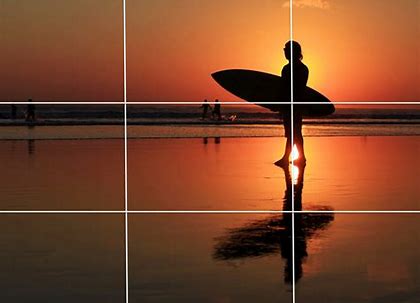
The rule of thirds states than an image is most pleasing when its subjects or regions are composed along imaginary lines which divide the image into thirds — both vertically and horizontally
Leading lines
Leading lines are the lines in a photograph that lead the viewer’s eye in and then out of frame. Sometimes they don’t lead the eye out of the frame at all, but cause the eye to circulate around the subject.
Most often the leading lines will start in the foreground and disappear into the background. They might converge to a point of infinity in the background. This creates a sense of movement through the image as the viewer’s eye journeys through.

The light shining on the child is a leading line directing the eye straight to the child, placed using the rule of thirds. The floor also acts as a leading line.

The path in the grass acts as a leading line taking the viewer into the shot to the subject and following her direction of movement out of frame

3 composition rules are in use: repetition of the pillars to create a leading line on camera right, repetition of lights to create a leading line on camera left, the pier on camera right as a leading line and placement of the subject using rule of thirds.

The lines of the material act as leading lines to the model’s face, as do her arms and the shoreline in the background.
Symmetry
Keeping your subject symmetrical is another good technique to use in photography. You can also achieve amazing results by exploring interesting ways to show symmetry in your subject(s) or finding a break in the symmetry.

Symmetry can be used in different ways in films. Some people claim that symmetry, being un-natural (how often do we see a purely symmetrical scene in nature) can be used to ‘jar’ the eye. make us uneasy. Classic use of this is in the film the shining. I think this work because the symmetry is SO absolute. Everything is mirrored right down to the twins. when symmetry is less absolute, then a symmetrical shot can actually be pleasing to the human eye as it has a sense of ‘order about it’. this can be as simple as placing tow people talking to each other on opposite sides of the frame.
 Film making for nature